The Solar Oracle Walkman: Difference between revisions
mNo edit summary |
m (→Abstract) |
||
| Line 4: | Line 4: | ||
</gallery> | </gallery> | ||
= Abstract = | = Abstract = | ||
The Solar Oracle Walkman is an experiment in energy trading and sound sculpture. By producing cyanotype and screen-printed patterns on the TiO₂ layer of dye-sensitized solar cells (DSSCs), each cell generates a unique I–V curve. These curves are trained through generative models such as RAVE (real-time audio variational auto-encoder) and extracted as latent embeddings. Anchored in the physical world, these distinctive and stable features serve as oracle-based identity authentication, functioning both as hardware anti-counterfeiting and as the basis for experimental energy transactions. They also provide a foundation for musical design: each patterned transparent DSSC acts like a mini-disc, capable of replaying an immediate, reproducible sonification tied to its pattern. | |||
In the first stage, I–V curves are collected in Max/MSP and decomposed into seven dimensions [FF, Vmpp/Voc, Impp/Isc, Rs*, Rsh*, Σκ, A*]. Features are extracted via Principal Component Analysis (PCA), then manually and a priori mapped to the latent inlets of the nn~ decoder to drive other RAVE models, achieving reproducible sound and identity recognition. The next stage will involve recording continuous I–V data under varying illumination and directly training a RAVE model, enabling its encoder to learn compact latent embeddings. These embeddings will support a dual-path design: real-time auditory rendering in Max/MSP and oracle-based on-chain submissions for energy verification and exchange. | |||
Using latent embeddings as an oracle is not merely verification but a translation of external “energetic differences and physical features” into a “semantic space.” Conceptually, RAVE is defined here as a latent oracle: truth does not appear as fixed fact but emerges from the interplay between two worlds—physical energy trajectories and cognitive sound generation. By combining reproducible voiceprints with controlled hallucination, the device becomes a divinatory machine linking matter, perception, and imagination. | |||
= Experiments = | = Experiments = | ||
The audio output of each "solar disc" are expected to be reproducible, generative and variational, like a period of generative music with clear mechanism rather than completely randomness. To make each solar glass a generative device, I firstly assume I need to design a hash operation to gain a “ voiceprint (V)” for each solar glass; A hash operation is the process of feeding input data such as numbers, text, files, or a set of I-V curve parameters—into a mathematical function or algorithm to produce a hash value. Hash algorithms can take input of any length but always generate a fixed-length output. They are designed to be fast to compute, yield the same output for the same input, and produce drastically different outputs when the input changes even slightly. Running a RAVE model on mobile or wearable hardware remains challenging. There is no suitable on-device solution yet. Jetson-nano-class devices are possible, but power consumption and big size makes them weak candidates for a wearable design. Current focus stays on data quality, dataset design, vector space preservation of sonification and the philosophical mechanism on a prototyping stage. | The audio output of each "solar disc" are expected to be reproducible, generative and variational, like a period of generative music with clear mechanism rather than completely randomness. To make each solar glass a generative device, I firstly assume I need to design a hash operation to gain a “ voiceprint (V)” for each solar glass; A hash operation is the process of feeding input data such as numbers, text, files, or a set of I-V curve parameters—into a mathematical function or algorithm to produce a hash value. Hash algorithms can take input of any length but always generate a fixed-length output. They are designed to be fast to compute, yield the same output for the same input, and produce drastically different outputs when the input changes even slightly. Running a RAVE model on mobile or wearable hardware remains challenging. There is no suitable on-device solution yet. Jetson-nano-class devices are possible, but power consumption and big size makes them weak candidates for a wearable design. Current focus stays on data quality, dataset design, vector space preservation of sonification and the philosophical mechanism on a prototyping stage. | ||
Revision as of 09:58, 29 August 2025
-

Sony WM-F107 exhibited in Solar Biennale 2025 in Lausanne.
-

The DIY I-V tester made by Marc Dusseiller.


Abstract
The Solar Oracle Walkman is an experiment in energy trading and sound sculpture. By producing cyanotype and screen-printed patterns on the TiO₂ layer of dye-sensitized solar cells (DSSCs), each cell generates a unique I–V curve. These curves are trained through generative models such as RAVE (real-time audio variational auto-encoder) and extracted as latent embeddings. Anchored in the physical world, these distinctive and stable features serve as oracle-based identity authentication, functioning both as hardware anti-counterfeiting and as the basis for experimental energy transactions. They also provide a foundation for musical design: each patterned transparent DSSC acts like a mini-disc, capable of replaying an immediate, reproducible sonification tied to its pattern. In the first stage, I–V curves are collected in Max/MSP and decomposed into seven dimensions [FF, Vmpp/Voc, Impp/Isc, Rs*, Rsh*, Σκ, A*]. Features are extracted via Principal Component Analysis (PCA), then manually and a priori mapped to the latent inlets of the nn~ decoder to drive other RAVE models, achieving reproducible sound and identity recognition. The next stage will involve recording continuous I–V data under varying illumination and directly training a RAVE model, enabling its encoder to learn compact latent embeddings. These embeddings will support a dual-path design: real-time auditory rendering in Max/MSP and oracle-based on-chain submissions for energy verification and exchange. Using latent embeddings as an oracle is not merely verification but a translation of external “energetic differences and physical features” into a “semantic space.” Conceptually, RAVE is defined here as a latent oracle: truth does not appear as fixed fact but emerges from the interplay between two worlds—physical energy trajectories and cognitive sound generation. By combining reproducible voiceprints with controlled hallucination, the device becomes a divinatory machine linking matter, perception, and imagination.
Experiments
The audio output of each "solar disc" are expected to be reproducible, generative and variational, like a period of generative music with clear mechanism rather than completely randomness. To make each solar glass a generative device, I firstly assume I need to design a hash operation to gain a “ voiceprint (V)” for each solar glass; A hash operation is the process of feeding input data such as numbers, text, files, or a set of I-V curve parameters—into a mathematical function or algorithm to produce a hash value. Hash algorithms can take input of any length but always generate a fixed-length output. They are designed to be fast to compute, yield the same output for the same input, and produce drastically different outputs when the input changes even slightly. Running a RAVE model on mobile or wearable hardware remains challenging. There is no suitable on-device solution yet. Jetson-nano-class devices are possible, but power consumption and big size makes them weak candidates for a wearable design. Current focus stays on data quality, dataset design, vector space preservation of sonification and the philosophical mechanism on a prototyping stage.
The DSSC voiceprints
I-V curve is often used to analysis the characteristics of a solar cell, therefore it is ideally the identity of the panel, especially the DSSC with cyanotyped and screen printded TiO2 layer. In this research, the shape of I-V curve is deconstructed into seven features that are often used to measure different characteristics of the panel, and then apply machine learning to each feature so the shape can be learned by the computer. This method is expected to ensures the irradiance invariance, so the reproducibility of the audio output of the solar disc will be resilient even it's put under different light exposure. The voiceprint V consists seven features of the I-V curve: V = [FF (Fill Factor), Vmpp/Voc, Impp/Isc, Rs (series resistance), Rsh (shunting resistance), sum of curvature, total area of the I-V curve]. Noticing the calculation made here are dimensionless. A dimensionless feature vector is a set of numerical descriptors that have been normalized so they no longer carry physical units such as volts, amperes, or ohms. By converting raw measurements into dimensionless quantities—for example, by taking ratios like Vmpp/Voc or Impp/Isc, the features capture only the relative shape or behavior of the data, independent of its absolute scale. This process is crucial when comparing or classifying I-V curves under varying light intensities, as it ensures that differences in the vector reflect intrinsic device characteristics rather than changes in measurement conditions. The feature definitions (scale-free) are listed below, and a script of javascript is created by GPT to generate these seven features in a Max patch:
-

DIY DSSC with screen printed pattern and hollyhock dye made by Shih Wei Chieh.
-

DIY DSSC with cyanotype pattern made by Shih Wei Chieh.
-

The measurement of the I-V curve tester is uploaded to Thingspeak and a local server, and can be fetched in Max/MSP.


The 7-D voiceprint is defined as:
V = [FF, Vmpp/Voc, Impp/Isc, Rs*, Rsh*, Σκ, A*]
All features are computed on a 64-point resampled I–V trace and normalized by Voc and Isc to be invariant to irradiance and device size.
- FF (fill factor)
FF = (Vmpp * Impp) / (Voc * Isc)
- Vmpp/Voc and Impp/Isc
- Scale-free ratios capturing the operating point at maximum power.
- Rs* and Rsh* (dimensionless ohmic estimates)
- First estimate the local slopes on the resampled curve:
Rs ≈ -ΔV/ΔI (evaluated near I ≈ Isc)Rsh ≈ -ΔV/ΔI (evaluated near V ≈ Voc)- Then report dimensionless forms:
Rs* = Rs * (Isc / Voc)Rsh* = Rsh * (Isc / Voc)
- Σκ (curvature_sum)
- Sum of absolute turning angles along the 64-point polyline of the I–V trace: for each consecutive pair of segments
s_i = (ΔV_i, ΔI_i), accumulate |angle(s_i, s_{i+1})|, and reportΣκ = Σ |angle(s_i, s_{i+1})|.- (Intuition: larger Σκ indicates a more “bent” I–V shape.)
- A* (normalized area under the I–V curve)
- Definition: area from V=0 to V=Voc divided by
(Isc * Voc). - Discrete approximation on the resampled trace:
A* ≈ (Σ I[i] * ΔV[i]) / (Isc * Voc)
Ml.scale and ml.principle To achieve the goal to recognize the shape of each "solar mini disc", ml.* library in Max/MSP could be a possible solution. Ml.* is a toolbox of machine learning algorithms implemented in Max to enable real-time interactive music and video with unsupervised machine learning, aimed at computer musicians and artists. The I-V curve tester is connected to computer and the 16 points of voltage and current measurements are sent to the computer via serial communications. The raw seven features are first sent to ml.scale object for the normalization in range from 0 to 1. The values are then passed to ml.principle, which performs Principal Component Analysis (PCA). This converts the seven values into a new 7-dimensional PCA space, though typically only the first two components (PC1 and PC2) carry most of the significant variance. In short, PCA is a mathematical method that rotates and compresses data into fewer dimensions while preserving as much variance as possible. ml.principle is the Max/MSP object that implements PCA: it learns the principal axes from training data, and then projects new data into that reduced space. I am not familiar with how fundamentally the mathematics works, however, I got an okay explanation from GPT below in the photo gallery.
-
![An example Max patch of the machine learning process for the raw seven features: [FF, Vmpp/Voc, Impp/Isc, Rs, Rsh, curvature_sum, area].](/images/thumb/2/2f/Iv_curve_machine_learning.png/339px-Iv_curve_machine_learning.png)
An example Max patch of the machine learning process for the raw seven features: [FF, Vmpp/Voc, Impp/Isc, Rs, Rsh, curvature_sum, area].
-

The mathematical explanation for the principle component analysis (PCA) made by GPT.
![An example Max patch of the machine learning process for the raw seven features: [FF, Vmpp/Voc, Impp/Isc, Rs, Rsh, curvature_sum, area].](/wiki/File:Iv_curve_machine_learning.png)

RAVE as latent oracle
I plan to collect sequential I–V data under varying illumination to build a dataset that captures the dynamic behavior of each DSSC module. This dataset will be used in Google Colab to train a RAVE model, where the encoder will learn compact latent embeddings of the cell’s non-linear characteristics. Subsequent measurements from the same DSSC will then be mapped into stable, reproducible embeddings, which will support a dual-path strategy: one directed to the decoder in Max/MSP for immediate auditory rendering, and the other transmitted to an oracle endpoint for statistical verification and on-chain submission.
The philosophical mechanism
This work therefore proposes a RAVE latent oracle, where the latent space of a variational auto-encoder becomes an interface between physical energy and machine intelligence. In blockchain, oracles provide trusted access to external signals; likewise, most AI models are closed symbolic systems without direct grounding. Here, DSSC I–V curves serve as fuzzy extractors, transforming noisy physical outputs into reproducible latent coordinates that act as oracle values. Philosophically, perception and AI can be understood as generative mechanisms: brains do not passively receive the world but predict and correct it, with hallucination as a mismatch case. In this system, the oracle plays a dual role: as an anchor, constraining generation with empirical data, and as an invocation, sustaining imagination under verification. The DSSC–RAVE pipeline thus demonstrates how controlled hallucination can serve both as a technical safeguard and as an artistic metaphor, transforming energy inputs into perceptual outputs.
-

Diagram of Stinson's generic mechanism.
-

A logical empiricist picture of a scientific theory. Reproduced from Herbert Feigl 1970.
-

Diagram of Stinson and Feigl's model applied to the current project structure.


The sonification of hallucinations
An interesting and simple strategy is to foreground hallucination as a sonic principle, I isolate what the model fails to explain. After training a RAVE on DSSC I–V sequences, each new measurement produces a latent embedding z1. Passing this through the encoder–decoder loop yields a reconstructed embedding z2. The residual vector r = z1 – z2 is then extracted: this residual represents precisely the component that lies outside the model’s learned prediction. While z1 captures the reproducible voiceprint of the cell, r embodies the “hallucination”—the deviation, noise, or anomaly that the model cannot assimilate. By routing only this residual into a separate RAVE decoder, the auditory output becomes a direct rendering of prediction mismatch. In this way, the system does not merely sonify energy curves, but also transforms epistemic failure into sound: hallucination is heard not as error, but as a generative surplus that destabilizes the boundary between perception and imagination.
  [IV curve]
       │
       ▼
  Encoder → z1
       │
       ▼
  Decoder → z2
       │
       ▼
  Residual r = z1 - z2
       │
       ▼
  Decoder2 → Sound of Hallucination
From sound reproducibility to semantic stability
At present, the sound engine simply connects the 7-dimensional voiceprint to the RAVE decoder inlets. This minimal design already yields strong reproducibility: each solar cell produces a stable sonic identity whenever measured. Yet in the absence of vector space preservation (VSP), the latent space remains primarily a registry of unique identities, sufficient for reproducibility but unable to guarantee meaningful relational structure among different cells. In practical terms, this means that an oracle built on the current pipeline can reliably answer whether a signal is genuine or not, but cannot provide further semantic interpretation of how one energy curve relates to another. Looking forward, methods from cross-modal embedding research (such as Jha et al. 2025 on vec2vec) suggest how this mapping could be formalized. According to Jha et al. (2025), semantic stability is maintained through three key constraints: reconstruction (the translated representation can be mapped back to the source), cycle-consistency (round-trips preserve meaning), and vector space preservation (VSP), which ensures that pairwise distances among embeddings remain intact across the mapping. Such ideas are not yet implemented, but they provide useful guidance for future experiments on how photovoltaic features might align more systematically with audio latent space.
-
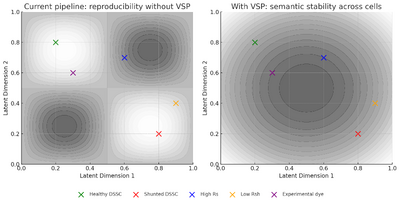
This figure contrasts the current pipeline with an idealized design that incorporates vector space preservation (VSP). On the left, reproducibility is achieved: each DSSC maps to a stable position in latent space, allowing identity verification but without meaningful relationships across cells. On the right, VSP ensures that pairwise distances in the latent space reflect differences in photovoltaic features, providing not only reproducibility but also relational meaning. In this view, the oracle evolves from a gatekeeper that validates authenticity into a “divinatory machine” that reveals how energy curves relate within a shared semantic structure.

Discussion
Where things are now The oracle walkman works as a simple art sculpture that sonifies DSSC I–V curves in real time. The 7-feature voiceprint is stable across illumination changes after normalization. The mapping is deliberately minimal, which makes evaluation of reproducibility straightforward. A controlled pipeline from sensing to sound is established in Max/MSP. Perception and AI are treated as two sides of the same generative mechanism. The working definition of hallucination is generation that drifts beyond admissible evidence and priors. Brains predict and correct; hallucination is an extreme case of prediction mismatch. The oracle provides external anchors to keep generation within verifiable bounds while leaving room for creative variance. What the theory is doing now Stinson’s generic-mechanism view motivates treating DSSC–RAVE and human perception as different instantiations of a common generative architecture. Feigl’s correspondence model motivates explicit bridges from observation to latent variables, so every design step is tied back to measurable traces. These theoretical lenses are not goals in themselves. They function as design guidelines for dataset building, priors for mapping, and evaluation metrics for drift and variance. Current limitations highlight the absence of vector space preservation (VSP). Without VSP, the latent space serves as a stable registry of identities but cannot guarantee relational meaning across cells. Thus, the oracle functions mainly as a gatekeeper that validates authenticity but offers little semantic interpretation. With VSP, however, the oracle could evolve into a “true oracle machine”: not only verifying truth but also revealing how different energy curves relate, translating physical differences into interpretable structures of another domain. Next steps Build a small but clean training set of DSSC voiceprints with controlled illumination and temperature, then test monotonicity and local smoothness priors. Prototype vec2vec-style constraints: simple cycle checks and distance preservation on a held-out set; log when sonic neighborhoods fail to match energy-curve neighborhoods. Investigate lightweight inference targets and compression for future mobile use. Explore whether traceable energy records can be registered as verifiable hashes derived from sonic voiceprint, then evaluate failure modes and anti-counterfeiting limits. The design of the solar mini disc walkman is therefore not only a music project. It also opens a measured way to ask whether energy can be traceable and traded, and how a physical voiceprint might act as an oracle that links matter, perception, and computation. With stronger constraints such as VSP, this oracle could transcend its role as a verifier and begin to function as a “machine of divination,” translating one world into another without collapsing artistic variability.
References
- Buckner, Cameron J. 2023. From Deep Learning to Rational Machines: What the History of Philosophy Can Teach Us about the Future of Artificial Intelligence. 1st ed. Oxford University PressNew York. https://doi.org/10.1093/oso/9780197653302.001.0001.
- Stinson, Catherine. 2020. “From Implausible Artificial Neurons to Idealized Cognitive Models: Rebooting Philosophy of Artificial Intelligence.” Philosophy of Science 87 (4): 590–611. https://doi.org/10.1086/709730.
- Jha, Rishi, Collin Zhang, Vitaly Shmatikov, and John X. Morris. 2025. “Harnessing the Universal Geometry of Embeddings.” arXiv:2505.12540. Preprint, arXiv, June 25. https://doi.org/10.48550/arXiv.2505.12540.
- https://www.hackteria.org/wiki/A_RAVE_and_starvation_synth_based_generative_sonic_device_powered_by_dye_sensitized_solar_cell
- https://github.com/shihweichieh2023/IVcurve_tester
- https://github.com/rjha18/vec2vec
- https://medium.com/@shihweichieh/generative-systems-and-extended-mind-as-transformation-similarity-models-connecting-two-cultures-0352458fe85c